
Is age estimation possible in vending machines? Vending machines have been around for much longer than people might consider. At minimum, the concept of a vending machine has been around for thousands of years. In 1 A.D. in ancient Egypt, a vending machine was created—when citizens would insert a coin a lever would lift to release water. Vending machines have highly developed since and can provide shoppers with a wide array of offerings.

How can you do identity verification?
Identity verification is a concept that is much different to age verification. Identity verification is exactly what it sounds like, it is the concept of being able to verify someone’s identity—the person at hand is the person they say they are (what is on their ID).
Identity verification happens in the physical and digital world. When you rent a car, for example, or board a plane, your identity needs to be verified—the important conclusion in this situation is that you are able to prove who you say you are.
Identity verification is important for many reasons. There are often important processes which individuals must carry out for themselves and only for themselves. The security measures here are that this person can prove who they are.
What is client identity verification?
Client verification is the same concept as identity verification except that it is more specific to businesses. In this type of verification, businesses are trying to ensure that the person at hand is their client.
Client verification has a broader scope because it encompasses all of the information necessary for a business to have a working relationship with a client. The length of this relationship, as well as the amount of information required of a client or customer, depends largely on the nature of the business.
How does age verification work?
Age verification is different to identity verification as it does not look to confirm someone is who they say they are. In age verification, it is only necessary to confirm that a person is either of an exact age or older than the minimum age requirement. In age verification, the identity, gender, nationality, etc. of a person does not matter.
Age verification is a type of verification that is necessary in situations where people must be of a certain age or age range to participate. Age verification is done in the physical world when you order alcohol at a restaurant or are trying to enter a nightclub. The person doing the age verification does not care who you are—they just want to make sure you are old enough to be in there.
How is identity verification done in a vending machine?
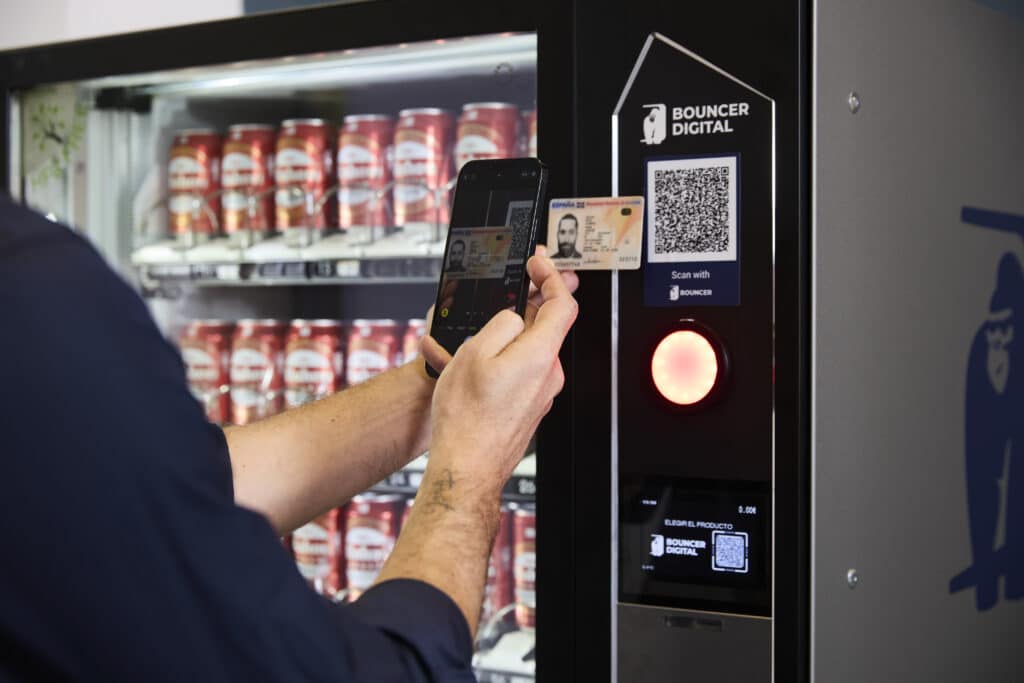
In a vending machine, identity verification is done traditionally with IDs. There is some physical integration of hardware installed or built into a vending machine. This integration therefore allows an ID to be read or scanned whilst a purchase is being completed. This is costly and time-consuming.
Identity verification in vending machines is also starting to become less dependent on hardware as vending machines become more and more high tech. That is to say, vending machines with ID readers used to require the installation of a camera or some sort of scanning mechanism.
In 2025, vending machines are starting to become more and more digital, often having only a screen. This means that the process of identity verification is easier as it would only require software integration.
How to do age verification in a vending machine?
Age verification in vending machines is a concept that makes a lot of sense when we consider that vending machines are starting to offer a variety of products such as alcohol, vapes, CBD, and tobacco. In the physical world of assisted shopping, acquiring these products would simply require a clerk to see that “yes, this person is probably above a certain age” or a quick glance at the birth year of an ID.
Age verification therefore makes sense in vending machines because at maximum level of security—like in the real world—the machine simply needs to confirm that you are over a certain age, but maybe age estimation in vending machines makes more sense.
What is age estimation in vending machines?
Perhaps the most perfect solution for selling restricted products is age estimation in vending machines. Age estimation in vending machines is a simple offering which works similar to face-to-face sale of restricted products. Age estimation in vending machines allows a user to scan their face and AI works to decide with 99.5% certainty whether or not the user is able to access the product.
Age estimation in vending machines makes the process fast and efficient—as the sale in a vending machine should be. In the case that the age estimation fails, a default KYC process will begin. Age estimation in vending machines therefore is secure in the same way that it is in the physical world as a clerk would only ask for someone’s ID when they are unsure if the person in front of them is over a certain age.
Age estimation in vending machines can be made easy with systems such as the one offered by Bouncer Digital. Age estimation in vending machines helps consumers reach their products faster and feel the same comfort and ease in regular vending machines sales.


